

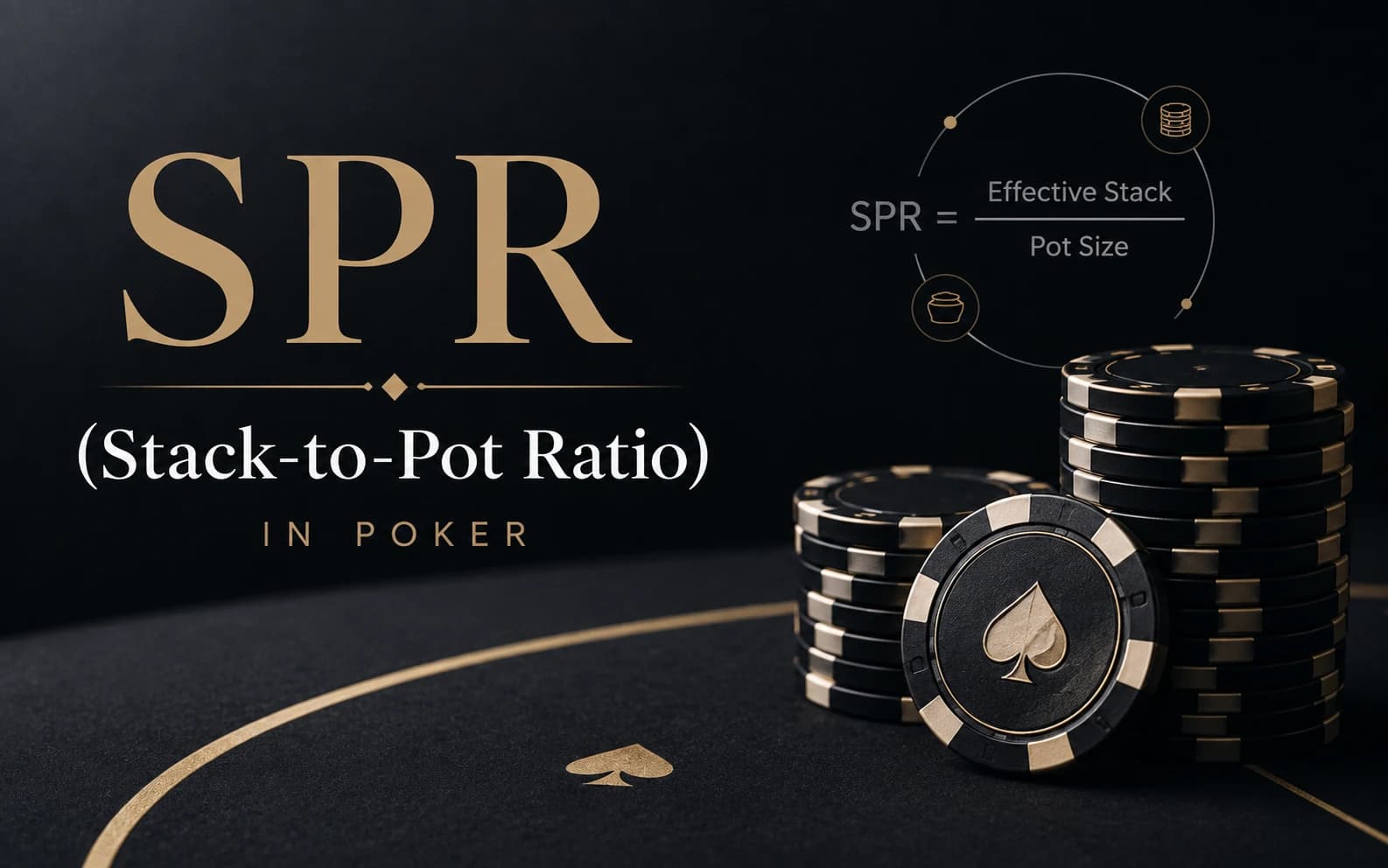
In Texas Hold'em it is easy to stall on “how far can I go with this one pair?” The number that answers that question is SPR. SPR (stack-to-pot ratio) is effective stack divided by the current pot.
When SPR is low, remaining chips sit close to the pot and one pair can often play for stacks. When SPR is high, you usually need two pair or better. This article covers the formula, low / medium / high zones, typical 100bb 6-max numbers, and how SPR is shown on nlh.poker.
What is SPR?
SPR is effective stack divided by the current pot. It tells you how many times the pot your remaining chips represent.
SPR 1 means one pot-sized bet gets the stacks in. SPR 10 means you would need about ten pot-sized bets. The same top pair is a different hand at SPR 1 than at SPR 10.
SPR does not rank your made hand. It measures how deep you still are versus the pot. For hand rankings see poker hand rankings. For which flop hands to bet or call, see the flop hand-selection guide.
What is effective stack?
You need effective stack before you can compute SPR. Effective stack is the amount actually in play in that hand: the smaller of your remaining stack and your opponent’s.
You have 100bb, they have 80bb: effective stack is 80bb. You cannot win or lose more than 80bb versus them. You have 40bb, they have 100bb: effective stack is 40bb.
Multiway note: with three or more players left, effective stack differs by opponent. Versus a short stack SPR is low; versus a deep stack it is high. Do not treat the table as having one SPR. Nearby terms are in the Texas Hold'em glossary.
How to calculate SPR
The formula is:
SPR = effective stack ÷ pot
Example: 90bb behind, 15bb in the pot → SPR = 90 ÷ 15 = 6.
If the remaining stack went in as one bet, the equity you need to call is the same math as pot odds. You risk SPR units into a final pot of 1 + 2×SPR, so required equity is SPR ÷ (1 + 2×SPR).
| SPR | Amount you risk (in pots) | Final pot | Equity needed |
|---|---|---|---|
| 1 | 1× | 3× | 33.3% |
| 2 | 2× | 5× | 40.0% |
| 3 | 3× | 7× | 42.9% |
| 4 | 4× | 9× | 44.4% |
| 6 | 6× | 13× | 46.2% |
| 13 | 13× | 27× | 48.1% |
Higher SPR means you need more equity to put the stack in. That is why one pair is not enough when stacks are deep. The table assumes the remainder goes in at once. In practice it is spread over streets, so range and board still matter.
SPR zones: low, medium, and high
Teaching material often uses these bands, popularized by Ed Miller and others, restated so beginners can remember them. They are commitment heuristics, not a GTO lookup table.
| SPR | Band | Hands that often stack off | One pair |
|---|---|---|---|
| ~4 or below | Low | Top pair, overpairs, strong draws | Often committed |
| ~4–13 | Medium | Strong top pair, two pair, sets, combo draws | Bet one or two streets; caution versus big raises |
| ~13 or above | High | Sets, two pair or better, nut-leaning draws | Not a stack-off hand |
At a low SPR, one large bet often ends the hand. Slowplaying top pair can miss value from weaker pairs and draws. At a high SPR the same top pair still faces huge turn and river bets, so losing to a set is much more expensive.
How to use the bands: 4 and 13 are not cliffs where hand strength jumps. In position on a dry board you can still bet an overpair thick at a medium SPR. Out of position on a wet board you can fold top pair even at SPR 3.
Typical SPRs at 100bb 6-max
nlh.poker tables always start at 100bb. Using SB 0.5bb, BB 1bb, and a 2.5bb open, flop SPR after typical 6-max lines looks like this.
| Preflop | Pot (approx.) | Behind | Flop SPR |
|---|---|---|---|
| BTN opens 2.5bb, BB calls (SB folds) | 5.5bb | 97.5bb | ~18 (high) |
| BTN 2.5bb, BB 3-bets to 11bb, BTN calls | 22.5bb | 89bb | ~4 (low) |
| BTN 2.5bb, BB 11bb, BTN 4-bets to 25bb, BB calls | 50.5bb | 75bb | ~1.5 (very low) |
Single-raised pots stay deep; one pair rarely wants to play for 100bb. Three-bet pots drop to SPR around 4, so strong one pair gains value. Four-bet pots sit near SPR 1.5—you are almost committed on the flop.
Position order is UTG → MP → CO → BTN → SB → BB. With three players the seats are BTN, SB, and BB. First to act is UTG preflop, then SB from the flop onward. Details: action order and position names.
Same one pair, different SPR
Same A-K, same A-7-2 flop—different SPR, different answer. Pair this with the flop hand-selection guide.
SPR ≈ 4: top pair in a 3-bet pot can commit
6-max, 100bb start. BTN opens 2.5bb, BB 3-bets to 11bb, BTN calls. Pot on the flop is 22.5bb, 89bb behind, SPR ≈ 4. BB acts first after the flop.





You are BB with top pair, top kicker. On a dry board at SPR about 4, if BTN raises the flop or turn you are often a stack-off candidate with one pair. There is little left relative to the pot, and the caller’s range still includes weaker aces, overpairs, and bluffs. Checking it down here tends to leave value on the table.
SPR ≈ 18: same hand, respect a check-raise
Same 6-max, 100bb. You open 2.5bb on the BTN, BB calls, SB folds. Pot on the flop is 5.5bb, 97.5bb behind, SPR ≈ 18.
Same hole cards, same board. Only SPR changed. A continuation bet from the button is natural, but if BB check-raises, shipping almost 100bb with one pair is dangerous. At a high SPR the raise range leans toward sets and two pair, and one pair no longer has the equity to commit. Take a street of value, then use pot control against a large raise: fold or call and re-evaluate.
Design SPR before the flop
SPR is not a surprise on the flop. Preflop sizing largely sets it. The SPR you want depends on the hand class.
Hands that make strong one pair want a lower SPR
A-A, K-K, and A-K often flop strong one pair or an overpair. Arriving at a high SPR makes it easier to lose a stack to a set. Three-betting to grow the pot and land near SPR 4 is how you make one pair playable for stacks. For starting-hand choice see preflop hand selection.
Hands that need a set or straight want SPR left behind
Small pocket pairs and suited connectors need implied odds. A higher SPR means more chips to win when you hit a set or straight. Calling in position and keeping SPR high fits this class.
A practical prompt: decide first whether you want to win with one pair or to get paid when you hit. That usually decides 3-bet versus call.
SPR vs pot odds and pot control
Keep these three tools in separate jobs.
| Concept | What it asks | When to use it |
|---|---|---|
| Pot odds | What equity do I need for this call? | Right after a bet, for this one hand |
| SPR | How many pots remain behind? | On the flop, to judge commitment for the whole hand |
| Pot control | Should I keep this medium hand small? | Medium-to-high SPR, steering one pair to a smaller pot |
Pot odds: pay now or not. SPR: can this hand play for stacks. Pot control: how to land small when it should not. Use them in that order; they do not contradict each other.
Common mistakes
How to check SPR on nlh.poker
nlh.poker shows SPR next to the pot in the center of the table. It compares your remaining stack with the deepest remaining opponent, takes the smaller number, and divides by the current pot. It hides the badge when the pot is 0 or every opponent has folded.
How to read the badge: the on-screen SPR updates street by street. That is useful for live depth. Teaching bands such as “SPR 4 or below, commit with top pair” still apply to flop SPR. After the hand, check flop SPR against your line in hand review. Where the UI lives is covered in the nlh.poker feature guide.
FAQ
What is SPR in poker?
SPR stands for stack-to-pot ratio. It is effective stack divided by the current pot: how many times the pot your remaining chips represent. Use it after the flop to judge how far you can go with a hand.
What is the SPR formula?
SPR = effective stack ÷ pot. If 90bb remain and the pot is 15bb, SPR = 90 ÷ 15 = 6. Heads-up, use the smaller of the two remaining stacks.
What is effective stack?
The amount actually in play in that hand: the smaller of your stack and your opponent’s. If they have 80bb and you have 100bb, effective stack is 80bb. You cannot win or lose more than that versus them.
What happens when SPR is low?
Remaining chips sit close to the pot, so one or two bets often get the stacks in. At SPR 4 or below, top pair and overpairs are frequently stack-off candidates. This is common in 3-bet and 4-bet pots.
At what SPR can I stack off with one pair?
A common teaching rule: SPR 4 or below, top pair or an overpair can often commit; SPR 13 or higher, you usually want two pair or better. Board texture, position, and the opponent’s range still matter—do not treat the number as a law.
Should I recalculate SPR on the turn and river?
The raw number changes as the pot grows. Commitment zones such as “SPR 4 or below, stack top pair” apply to flop SPR. A turn SPR of 4 does not upgrade a one-pair hand that started deep on the flop.
Summary
- SPR = effective stack ÷ pot. It is remaining chips in units of the current pot.
- About 4 or below, one pair can often commit. About 13 or above, you usually want two pair or better.
- At 100bb 6-max: open-and-call ≈ SPR 18, 3-bet pots ≈ 4, 4-bet pots ≈ 1.5.
- The same top pair answers a check-raise differently at SPR 4 than at SPR 18.
- Use flop SPR for the teaching bands. The live badge is current depth, not a reason to re-band the hand.
Next session, glance at SPR when the flop is dealt. Deciding “how far does this one pair go?” from that number cuts a lot of feel-based stack-offs. Free tables are at nlh.poker.
Related articles
- Pot odds: how to calculate call or fold
- Pot control: when to keep the pot small
- Flop hand-selection guide
- Preflop hand selection
- How to review hands
- Texas Hold'em glossary
References
- Ed Miller, Matt Flynn, Sunny Mehta, Professional No-Limit Hold'em: Volume 1 (Two Plus Two Publishing, 2007) — the book that popularized SPR
- GTO Wizard: Stack-to-pot ratio (SPR and required equity)